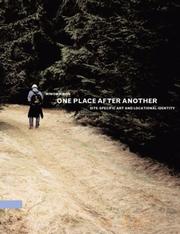
One Place after Another
Miwon Kwon · 2004
Where to buy
Check today’s price on Amazon. We do not show prices because they change daily.
View on AmazonAffiliate link. As an Amazon Associate we earn from qualifying purchases.
About the book
A critical history of site-specific art since the late 1960s. Site-specific art emerged in the late 1960s in reaction to the growing commodification of art and the prevailing ideals of art's autonomy and universality. Throughout the 1970s and 1980s, as site-specific art intersected with land art, process art, performance art, conceptual art, installation art, institutional critique, community-based art, and public art, its creators insisted on the inseparability of the work and its context. In recent years, however, the presumption of unrepeatability and immobility encapsulated in Richard Serra's famous dictum "to remove the work is to destroy the work" is being challenged by new models of site specificity and changes in institutional and market forces. One Place after Another offers a critical history of site-specific art since the late 1960s and a theoretical framework for examining the rhetoric of aesthetic vanguardism and political progressivism associated with its many permutations. Informed by urban theory, postmodernist criticism in art and architecture, and debates concerning identity politics and the public sphere, the book addresses the siting of art as more than an artistic problem. It examines site specificity as a complex cipher of the unstable relationship between location and identity in the era of late capitalism. The book addresses the work of, among others, John Ahearn, Mark Dion, Andrea Fraser, Donald Judd, Renee Green, Suzanne Lacy, Inigo Manglano-Ovalle, Richard Serra, Mierle Laderman Ukeles, and Fred Wilson.
Book details
- Year
- 2004
- Language
- English
- Publisher
- The MIT Press
- Editions
- 4
- Pages
- 230
- ISBN
- 9780262612029
Data source: Wikidata