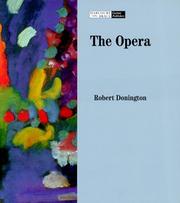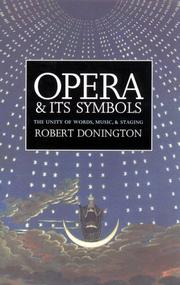
Opera and its symbols
Robert Donington · 1992
Where to buy
Amazon’s price changes daily, so the most accurate place to see it is there, at the moment you buy.
View on AmazonThis is an affiliate link: if you buy through it, the site earns a small commission at no extra cost to you, which helps us bring quality content and maintain the site. As an Amazon Associate we earn from qualifying purchases.
About the book
Robert Donington, the noted musicologist, performer, and writer, is famous for his influential and provocative book Wagner's "Ring" and Its Symbols, and for his indispensable reference work The Interpretation of Early Music. In this book he discusses the workings of symbolism in opera and the importance of staging opera in keeping with the composer's intentions. Only in this way, says Donington, can we be faithful to the conscious or unconscious symbolism invested in the work by the composer and librettist. Starting form Carlyle's premise that "it is through symbols that man, consciously or unconsciously, lives, works and has his being," Donington interprets scenes and characters from operas by Monteverdi, Mozart, Verdi, Wagner, Bizet, Puccini, Debussy, Strauss, Stravinsky, Berg, Britten, Tippett, and other composers. Time and again Donington sheds new light on operatic situations that are problematic or have become over-familiar. His lively and wide-ranging work reveals a deep knowledge and love of opera, combined with a rare insight into hidden meanings to be found in music, words, and action [Publisher description].
Book details
- Year
- 1992
- Language
- English
- Publisher
- Yale University Press
- Editions
- 1
- Pages
- 256
- ISBN
- 9780300056617
Data source: Wikidata
More by Robert Donington