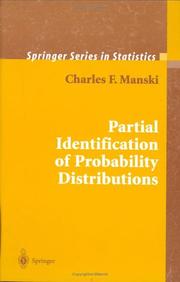
Partial Identification of Probability Distributions
Charles F. Manski · 2003
Where to buy
Amazon’s price changes daily, so the most accurate place to see it is there, at the moment you buy.
View on AmazonThis is an affiliate link: if you buy through it, the site earns a small commission at no extra cost to you, which helps us bring quality content and maintain the site. As an Amazon Associate we earn from qualifying purchases.
About the book
Sample data alone never suffice to draw conclusions about populations. Inference always requires assumptions about the population and sampling process. Statistical theory has revealed much about how strength of assumptions affects the precision of point estimates, but has had much less to say about how it affects the identification of population parameters. Indeed, it has been commonplace to think of identification as a binary event – a parameter is either identified or not – and to view point identification as a pre-condition for inference. Yet there is enormous scope for fruitful inference using data and assumptions that partially identify population parameters. This book explains why and shows how. The book presents in a rigorous and thorough manner the main elements of Charles Manski’s research on partial identification of probability distributions. One focus is prediction with missing outcome or covariate data. Another is decomposition of finite mixtures, with application to the analysis of contaminated sampling and ecological inference. A third major focus is the analysis of treatment response. Whatever the particular subject under study, the presentation follows a common path. The author first specifies the sampling process generating the available data and asks what may be learned about population parameters using the empirical evidence alone. He then ask how the (typically) setvalued identification regions for these parameters shrink if various assumptions are imposed. The approach to inference that runs throughout the book is deliberately conservative and thoroughly nonparametric. Conservative nonparametric analysis enables researchers to learn from the available data without imposing untenable assumptions. It enables establishment of a domain of consensus among researchers who may hold disparate beliefs about what assumptions are appropriate. Charles F. Manski is Board of Trustees Professor at Northwestern University. He is author of Identification Problems in the Social Sciences and Analog Estimation Methods in Econometrics. He is a Fellow of the American Academy of Arts and Sciences, the American Association for the Advancement of Science, and the Econometric Society.
Book details
- Year
- 2003
- Language
- English
- Publisher
- Springer
- Editions
- 2
- Pages
- 178
- ISBN
- 9780387004549
Data source: Wikidata
More by Charles F. Manski