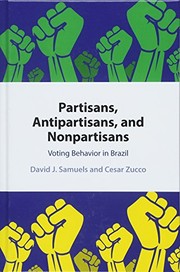
Partisans, Antipartisans, and Nonpartisans
David J. Samuels, Cesar Zucco · 2018
Where to buy
Amazon’s price changes daily, so the most accurate place to see it is there, at the moment you buy.
View on AmazonThis is an affiliate link: if you buy through it, the site earns a small commission at no extra cost to you, which helps us bring quality content and maintain the site. As an Amazon Associate we earn from qualifying purchases.
About the book
"Conventional wisdom suggests that partisanship has little impact on voter behavior in Brazil; what matters most is pork-barreling, incumbent performance, and candidates' charisma. This book shows that soon after redemocratization in the 1980s, over half of Brazilian voters expressed either a strong affinity or antipathy for or against a particular political party. In particular, that the contours of positive and negative partisanship in Brazil have mainly been shaped by how people feel about one party - the Workers' Party (PT). Voter behavior in Brazil has largely been structured around sentiment for or against this one party, and not any of Brazil's many others. We show how the PT managed to successfully cultivate widespread partisanship in a difficult environment, and also explain the emergence of anti-PT attitudes. We then reveal how positive and negative partisanship shape voters' attitudes about politics and policy, and how they shape their choices in the ballot booth. The idea for this book has deep roots for both of us. Samuels' first exposure to Brazil came in 1992, when he lived in Brasilia, living as a guest of and working as a sort of intern for PT federal deputy Jaques Wagner, who later went on to serve as Minister of Labor and Chief of Sta under Lula, two terms as governor of Bahia, and Chief of Sta and Minister of Defense under Dilma"--
Book details
- Year
- 2018
- Language
- English
- Publisher
- Cambridge University Press
- Editions
- 5
- Pages
- 196
- ISBN
- 9781108428880
Data source: Wikidata
More by David J. Samuels