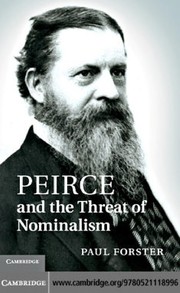
Peirce and the threat of nominalism
Paul Forster · 2011
Where to buy
Amazon’s price changes daily, so the most accurate place to see it is there, at the moment you buy.
View on AmazonAbout the book
"Charles Peirce, the founder of pragmatism, was a thinker of extraordinary depth and range - he wrote on philosophy, mathematics, psychology, physics, logic, phenomenology, semiotics, religion and ethics - but his writings are difficult and fragmentary. This book provides a clear and comprehensive explanation of Peirce's thought. His philosophy is presented as a systematic response to 'nominalism', the philosophy which he most despised and which he regarded as the underpinning of the dominant philosophical worldview of his time. The book explains Peirce's challenge to nominalism as a theory of meaning and shows its implications for his views of knowledge, truth, the nature of reality, and ethics. It will be essential reading both for Peirce scholars and for those new to his work"-- "Charles Peirce, the founder of pragmatism, was a thinker of extraordinary depth and range - he wrote on philosophy, mathematics, psychology, physics, logic, phenomenology, semiotics, religion and ethics - but his writings are difficult and fragmentary. This book provides a clear and comprehensive explanation of Peirce's thought. His philosophy is presented as a systematic response to 'nominalism', the philosophy which he most despised and which he regarded as the underpinning of the dominant philosophical worldview of his time. The book explains Peirce's challenge to nominalism as a theory of meaning and shows its implications for his views of knowledge, truth, the nature of reality and ethics. It will be essential reading both for Peirce scholars and for those new to his work"--
Book details
- Year
- 2011
- Language
- English
- Publisher
- Cambridge University Press
- Editions
- 1
- Pages
- 259
- ISBN
- 9780521118996
Data source: Wikidata