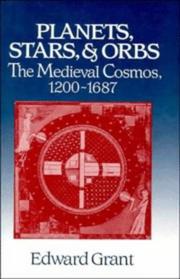
Planets, Stars, and Orbs
Edward Grant · 1994
Where to buy
Amazon’s price changes daily, so the most accurate place to see it is there, at the moment you buy.
View on AmazonAbout the book
Medieval cosmology was a fusion of pagan Greek ideas and biblical descriptions of the world, especially the creation account in Genesis. Because cosmology was based on discussions of the relevant works of Aristotle, primary responsibility for its study fell to scholastic theologians and natural philosophers in the universities of western Europe from the thirteenth to the seventeenth century. The present work describes the extraordinary range of themes, ideas, and arguments that constituted scholastic cosmology for approximately five hundred years from around 1200 to 1700. Primary emphasis is placed on the world as a whole, what might lie beyond it, and the celestial region, which extended from the Moon to the outermost convex surface of the cosmos . During the late Middle Ages (ca. 1200-1500), Aristotelian cosmology met little opposition or challenge. By the time rival interpretations appeared in the sixteenth century - for example, Platonism, atomism, Stoicism, Neoplatonism, Hermeticism, and especially Copernicanism - Aristotelian cosmology was firmly entrenched. By the seventeenth century, however, Copernican heliocentric cosmology and the geoheliocentric variant of it, proposed by Tycho Brahe, offered significant alternatives and thereby challenged medieval Aristotelian cosmology as never before. How scholastic natural philosophers of the sixteenth and seventeenth centuries responded to the new interpretations is an important aspect of this study
Book details
- Year
- 1994
- Language
- English
- Publisher
- Cambridge University Press
- Editions
- 1
- Pages
- 842
- ISBN
- 9780521565097
Data source: Wikidata
More by Edward Grant