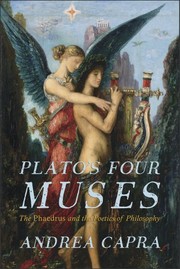
Plato's Four Muses
Andrea Capra · 2015
Where to buy
Amazon’s price changes daily, so the most accurate place to see it is there, at the moment you buy.
View on AmazonAbout the book
Plato's Four Muses reconstructs Plato's authorial self-portrait through a fresh reading of the Phhaedrus, with an Introduction and Conclusion that contextualize the construction more broadly. The reference to four Muses in the myth of the cicadas is read as a hint of the "ingredients" of philosophical discourse, which Plato sets against the Greek tradition of poetic initiations and conceptualizes as a form of provocatively old-fasioned 'mousikē'.The book unravels three surprising features that define Plato's works. First, there is a measure of anti-intellectualism: Plato counters the rationalistic excesses of other forms of discourse, thus distinguishing his own words from both prose and poetry; second, Plato envisages a new beginning for philosophy: he conceptualizes the birth of Socratic dialogue in, and against, the Pythagorean tradition, with an emphasis on the new role of writing and on the cult of Socrates in the Academy; finally, a self-consciously ambivalent attitude emerges with respect to the social function of the dialogues. Plato's works are conceived both as a kind of “resistance literature” and as a preliminary move towards the new poetry of the Kallipolis.
Book details
- Year
- 2015
- Language
- English
- Publisher
- Center for Hellenic Studies
- Editions
- 1
- Pages
- 252
- ISBN
- 9780674417229
Data source: Wikidata