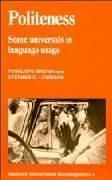
Politeness
Penelope Brown · 2018
Where to buy
Amazon’s price changes daily, so the most accurate place to see it is there, at the moment you buy.
View on AmazonThis is an affiliate link: if you buy through it, the site earns a small commission at no extra cost to you, which helps us bring quality content and maintain the site. As an Amazon Associate we earn from qualifying purchases.
About the book
"This study is about the principles for constructing polite speeches. The core of it first appeared in Questions and Politeness, edited by Esther N. Goody (now out of print). It is here reissued with a fresh introduction that surveys the considerable literature in linguistics, psychology and the social sciences that the original extended essay stimulated, and suggests distinct directions for research. The authors describe and account for some remarkable parallelisms in the linguistic construction of utterances with which people express themselves in different languages and cultures. A motive for these parallels is isolated - politeness, broadly defined to include both polite friendliness and polite formality - and a universal model is constructed outlining the abstract principles underlying polite usages. This is based on the detailed study of three unrelated languages and cultures: the Tamil of South India, the Tzeltal spoken by Mayan Indians in Chiapas, Mexico, and the English of the USA and England, supplemented by examples from other cultures. Underneath the apparent diversity of polite behaviour in different societies lie some general pan-human principles of social interaction, and the model of politeness provides a tool for analysing the quality of social relations in any society. This volume will be of special interest to students in linguistic pragmatics, sociolinguistics, applied linguistics, anthropology, and the sociology and social psychology of interaction."--Publisher's web site.
Book details
- Year
- 2018
- Language
- English
- Publisher
- Cambridge University Press
- Editions
- 1
- ISBN
- 9780511813085
Data source: Wikidata