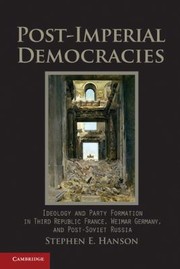
Post-imperial democracies
Stephen E. Hanson · 2010
Where to buy
Amazon’s price changes daily, so the most accurate place to see it is there, at the moment you buy.
View on AmazonAbout the book
"This book examines the causal impact of ideology through a comparative-historical analysis of three cases of "post-imperial democracy": the early Third Republic in France (1870-1886); the Weimar Republic in Germany (1918-1934); and post-Soviet Russia (1992-2008). Hanson argues that political ideologies are typically necessary for the mobilization of enduring, independent national party organizations in uncertain democracies. Clear and consistent ideologies can artificially elongate the temporal horizons of their adherents. By presenting an explicit and desirable picture of the political future, successful ideologues induce individuals to embrace a long-run strategy of cooperation with other converts. When enough new converts cooperate in this way, it enables sustained collective action to defend and extend party power. Successful party ideologies thus have the character of self-fulfilling prophecies: by portraying the future polity as one organized to serve the interests of those loyal to specific ideological principles, they help to bring political organizations centered on these principles into being"--
Book details
- Year
- 2010
- Language
- English
- Series
- Cambridge studies in comparative politics
- Publisher
- Cambridge University Press
- Editions
- 1
- ISBN
- 9780521883511
Data source: Wikidata
More by Stephen E. Hanson