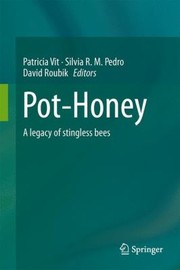
Pot-Honey
Patricia Vit · 2013
Where to buy
Amazon’s price changes daily, so the most accurate place to see it is there, at the moment you buy.
View on AmazonThis is an affiliate link: if you buy through it, the site earns a small commission at no extra cost to you, which helps us bring quality content and maintain the site. As an Amazon Associate we earn from qualifying purchases.
About the book
<p>The meliponines, stingless honey-making bees, encircle the tropical world and penetrate every forest there. This book brings together and synthesizes, on a global scale and for the first time, information on these bees as honey producers and natural alchemists. Their ability to store their food in flexible cerumen ‘pots’ made from wax and resin enables them to produce honey for which the world has no other source. These little known and often rare denizens of remote reaches of the globe have found a way to produce honey and survive in the permanently wet and unforgiving rain forests, since before the continents of Africa and South America split apart 100 million years ago. In Australia, we find them equipped to survive in cold deserts, and in the Amazon some feed within the nests of other social bees, utilize flesh of dead animals, or even live among scale bugs that give them food and building material. Some are obligate parasites, stealing the brood food from inside nests of other meliponines. Pot-honey is a minor honey in the market but a major honey in the forest, produced by many hundreds of flowering plants and demanding integrated conservation. Complementing the unifloral honeys of <i>Apis mellifera</i>, many more pot-honeys are yet to be appreciated by the public. The analytical corpus developed to study and standardize honey produced in combs is also valid for pot-honey. Honey ferments inside the nests of Meliponini, and the process continues after harvest. According to <i>A. mellifera </i>standards it is spoiled, yet a more medicinal product results and may remodel our concept of honey. As shown here, the meliponines, support a legacy of bees interacting with human culture, traditions, art, science and philosophy. </p>
Book details
- Year
- 2013
- Language
- English
- Publisher
- Springer New York
- Editions
- 3
- Pages
- 697
- ISBN
- 9781461449607
Data source: Wikidata
More by Patricia Vit