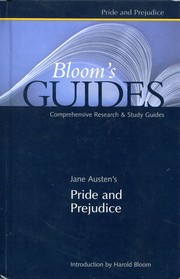
Pride and Prejudice
Harold Bloom · 2004
Where to buy
Amazon’s price changes daily, so the most accurate place to see it is there, at the moment you buy.
View on AmazonThis is an affiliate link: if you buy through it, the site earns a small commission at no extra cost to you, which helps us bring quality content and maintain the site. As an Amazon Associate we earn from qualifying purchases.
About the book
If the authentic test for a great novel is rereading, and the joys of yet further rereadings, then Pride and Prejudice can rival any novel ever written. Though Jane Austen, unlike Shakespeare, practices an art of rigorous exclusion, she seems to me finally the most Shakespearean novelist in the language. When Shakespeare wishes to, he can make all his personages, major and minor, speak in voices entirely their own, self-consistent and utterly different from one another. Since voice in both writers is an image of personality and also of character, the reader of Austen encounters an astonishing variety of selves in her socially confined world. Though that world is essentially a secularized culture, the moral vision dominating it remains that of the Protestant sensibility. Austen's heroines waver in one judgment or another, but they hold fast to the right of private judgment as the self's fortress. What they call "affection" we term "love," of the enduring rather than the Romantic variety, and when they judge a man to be "amiable," it is akin to whatever superlative each of us may favor for an admirable, human person. Where they may differ from us, but more in degree than in kind, is in their profound reliance upon the soul's exchanges of mutual esteem with other souls. In Pride and Prejudice and Emma in particular, your accuracy in estimating the nature and value of another soul is intimately allied to the legitimacy of your self-esteem, your valid pride. - Introduction.
Book details
- Year
- 2004
- Language
- English
- Publisher
- Chelsea House Publications
- Editions
- 1
- Pages
- 122
- ISBN
- 9780791081693
Data source: Wikidata
More by Harold Bloom