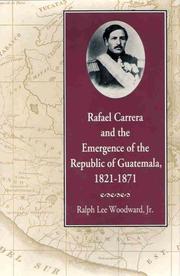
Rafael Carrera and the emergence of the Republic of Guatemala, 1821-1871
Ralph Lee Woodward · 1993
Where to buy
Amazon’s price changes daily, so the most accurate place to see it is there, at the moment you buy.
View on AmazonAbout the book
Caudillismo, the personality cult of the "great man," has been a primary catalyst in Central American politics since the Spanish Conquest. In Guatemala, where this passion for charismatic and forceful leaders is especially strong. Rafael Carrera is unrivaled in the length of his domination and the depth of his popularity. Based on extensive research in Central American archives, this monumental, revisionist narrative provides the most balanced and detailed account to date of Carrera's times and of his conservative legacy. Ralph Lee Woodward, Jr., explains the political, social, economic, and cultural circumstances that preceded and then facilitated Carrera's ascendancy and also shows how Carrera in turn fomented changes that persisted long after his death and far beyond the borders of Guatemala. An illiterate drifter of mixed blood, Rafael Carrera began his rise to power in 1837, on the eve of a conservative backlash against years of liberal rule in Guatemala.^ For more than a decade reforms aimed at rapid modernization and development had chipped away at the country's old Spanish institutions and customs - alienating and finally galvanizing the country's creole patriarchy, the Catholic Church, and the devout, tradition-bound peasantry. Carrera first led a small revolt in a mountainous rural district of eastern Guatemala, and as similar isolated uprisings escalated into a bloody, full-scale, reactionary revolution, he advanced quickly through the insurgents' ranks. A brilliant military strategist and tactician and an intuitive problem solver, Carrera knew how to charm people even as he exploited them, and he regarded brutality as a legitimate political tool. By 1839, at age twenty-five, he commanded the Guatemalan army; he was to remain the dominant caudillo on the isthmus, almost without interruption, until his death in 1865. Woodward establishes Carrera as an aberration of regional politics.^ He emerged from the revolution as something of a rural populist, able to mobilize Indians, Ladinos, and other segments of society that were disdained and feared by elites of all political leanings. His sway over the common people forced the elite factions to lay aside political differences in the interest of preserving their social status. Carrera himself thrived amid the resulting intrigue and ideological bickering, so secure at home that he often sent troops into neighboring countries to oust liberal elements. In this context of turmoil, Woodward traces many of Ce
Book details
- Year
- 1993
- Language
- English
- Publisher
- University of Georgia Press
- Editions
- 1
- Pages
- 648
- ISBN
- 9780820330655
Data source: Wikidata
More by Ralph Lee Woodward