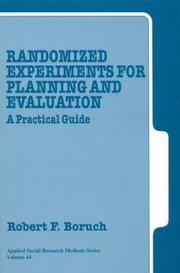
Randomized experiments for planning and evaluation
Robert F. Boruch · 1996
Where to buy
Check today’s price on Amazon. We do not show prices because they change daily.
View on AmazonAffiliate link. As an Amazon Associate we earn from qualifying purchases.
About the book
How can you tell if a new program has been effective or not? Is there any way to predict how a group of individuals would have fared without the new program or service? Packed with rich and varied examples, Robert F. Boruch's book untangles the complexities of randomized field experiments so that researchers can better evaluate the impact of new programs. Beginning with an exploration of how to judge whether or not a program worked (and for how much), Boruch explores the context of experiments; the standards used to judge the ethical propriety of randomized experiments; methods for studying populations; and sampling methods, including pilot tests and arrangements for random allocation. He also covers baseline measures, including when to measure costs; missing data registry; and analyses of quality assurance, including analyses that have to be engineered to suit the departures from the design. Randomized Experiments for Planning and Evaluation is thoughtfully written, providing researchers with a reliable guide for constructing their own randomized field experiments. Randomized Experiments for Planning and Evaluation is for all professionals and practitioners in evaluation/research methods, statistics, psychology, sociology, political science, social work, and public health.
First sentence: Estimating the effect of a new social or educational program requires comparing the condition of the individuals who have received the new service.
Book details
- Year
- 1996
- Language
- English
- Publisher
- Sage Publications, Inc
- Editions
- 1
- Pages
- 280
- ISBN
- 9780803935105
Data source: Wikidata
More by Robert F. Boruch