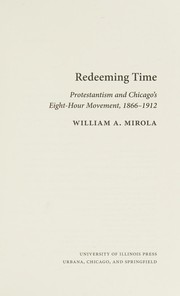
Redeeming Time
William A. Mirola · 2014
Where to buy
Check today’s price on Amazon. We do not show prices because they change daily.
View on AmazonAffiliate link. As an Amazon Associate we earn from qualifying purchases.
About the book
"During the struggle for the eight-hour workday and a shorter workweek, Chicago emerged as an important battleground for workers in "the entire civilized world" to redeem time from the workplace in order to devote it to education, civic duty, health, family, and leisure. William A. Mirola explores how the city's eight-hour movement intersected with a Protestant religious culture that supported long hours to keep workers from idleness, intemperance, and secular leisure activities. Analyzing how both workers and clergy rewove working-class religious cultures and ideologies into strategic and rhetorical frames, Mirola shows how every faith-based appeal contested whose religious meanings would define labor conditions and conflicts. As he notes, the ongoing worker-employer tension transformed both how clergy spoke about the eight-hour movement and what they were willing to do, until intensified worker protest and employer intransigence spurred Protestant clergy to support the eight-hour movement even as political and economic arguments eclipsed religious framing. A revealing study of an era and a movement, Redeeming Time illustrates the potential--and the limitations--of religious culture and religious leaders as forces in industrial reform"-- "Exploring the intersection between Chicago's eight-hour movement and Protestant religious culture over a fifty-year span, this project considers how workers and clergy contested the religious meaning of the eight-hour system and the legitimacy of legislating limitations on overwork. Showing that behind every religious appeal was a contest over whose religious meanings would define industrial conditions and conflicts in Chicago, William Mirola examines how both workers and Protestant clergy wove and rewove working-class religious cultures and ideologies into strategic and rhetorical frames around the issue of an eight-hour workday. Mirola traces the successive framing of eight-hour reform from pre-1880s, when most Protestant clergy supported long hours to keep workers from idleness, intemperance, and secular leisure activities, through the 1890s, when eight-hour support among Protestant clergy gained ground as the result of a new social consciousness spurred by intensified worker protest and ongoing employer resistance to limiting working hours, into the early decades of the twentieth century, as religious framing of the eight-hour movement declined in favor of political and economic arguments. Mirola argues that the ongo
Book details
- Year
- 2014
- Language
- English
- Publisher
- University of Illinois Press
- Editions
- 3
- Pages
- 240
- ISBN
- 9780252038839
Data source: Wikidata