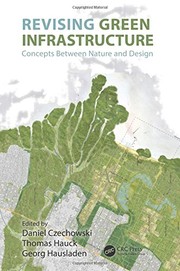
Revising Green Infrastructure
Daniel Czechowski, Thomas Hauck, Hausladen Georg · 2014
Where to buy
Amazon’s price changes daily, so the most accurate place to see it is there, at the moment you buy.
View on AmazonThis is an affiliate link: if you buy through it, the site earns a small commission at no extra cost to you, which helps us bring quality content and maintain the site. As an Amazon Associate we earn from qualifying purchases.
About the book
"Revising Green Infrastructure: Concepts Between Nature and Design examines ... questions and presents innovative approaches in designing green, landscape or nature as infrastructure from different perspectives and attitudes instead of adding another definition or category of green infrastructure. The editors bring together the work of selected ecologists, engineers, and landscape architects who discuss a variety of theoretical aspects, research projects, teaching methods, and best practice examples in green infrastructure. The approaches range from retrofitting existing infrastructures through landscape-based integrations of new infrastructures and envisioning prospective landscapes as hybrids, machines, or cultural extensions. The book explores a scientific functional approach in landscape architecture. It begins with an overview of green functionalism and includes examples of how new design logics are deducted from ecology in order to meet economic and environmental requirements and open new aesthetic relationships toward nature. The contributors share a decidedly cultural perspective on nature as landscape. Their ecological view emphasizes the individual nature of specific local situations. Building on this foundation, the subsequent chapters present political ideas and programs defining social relations toward nature and their integration in different planning systems as well as their impact on nature and society. They explore different ways of participation and cooperation within cities, regions, and nations. They then describe projects implemented in local contexts to solve concrete problems or remediate malfunctions. These projects illustrate the full scope presented and discussed throughout the book: the use of scientific knowledge, strategic thinking, communication with municipal authorities and local stakeholders, design implementation on site, and documentation and control of feedback and outcome with adequate indicators and metrics. Although diverse and sometimes controversial, the discussion of how nature is regarded in contrast to society, how human-natural systems could be organized, and how nature could be changed, optimized, or designed raises the question of whether there is a new paradigm for the design of social relations to nature. The multidisciplinary review in this book brings together discussions previously held only within the respective disciplines, and demonstrates how they can be used to develop new methods and remediation str
Book details
- Year
- 2014
- Language
- English
- Publisher
- Taylor & Francis Group
- Editions
- 7
- Pages
- 488
- ISBN
- 9781482232202
Data source: Wikidata