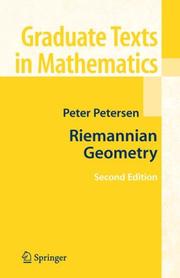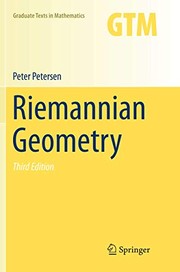
Riemannian Geometry
Peter Petersen · 2016
Where to buy
Amazon’s price changes daily, so the most accurate place to see it is there, at the moment you buy.
View on AmazonThis is an affiliate link: if you buy through it, the site earns a small commission at no extra cost to you, which helps us bring quality content and maintain the site. As an Amazon Associate we earn from qualifying purchases.
About the book
This book is intended for a one year course in Riemannian Geometry. It will serve as a single source, introducing students to the important techniques and theorems while also containing enough background on advanced topics to appeal to those students wishing to specialize in Riemannian Geometry. Instead of variational techniques, the author uses a unique approach emphasizing distance functions and special coordinate systems. He also uses standard calculus with some techniques from differential equations, instead of variational calculus, thereby providing a more elementary route for students. Many of the chapters contain material typically found in specialized texts and never before published together in one source. Key sections include noteworthy coverage of: geodesic geometry, Bochner technique, symmetric spaces, holonomy, comparison theory for both Ricci and sectional curvature, and convergence theory. This volume is one of the few published works to combine both the geometric parts of Riemannian geometry and the analytic aspects of the theory as well as presenting the most up-to-date research including sections on convergence and compactness of families of manifolds. This book will appeal to readers with a knowledge of standard manifold theory, including such topics as tensors and Stoke's theorem. Scattered throughout the text is a variety of exercises which will help to motivate readers to deepen their understanding of the subject.
Book details
- Year
- 2016
- Language
- English
- Publisher
- Springer International Publishing AG
- Editions
- 9
- Pages
- 517
- ISBN
- 9783319266527
Data source: Wikidata
More by Peter Petersen