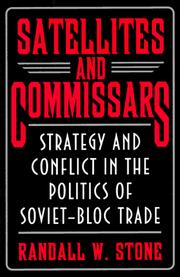
Satellites and Commissars
Randall W. Stone · 1996
Where to buy
Check today’s price on Amazon. We do not show prices because they change daily.
View on AmazonAffiliate link. As an Amazon Associate we earn from qualifying purchases.
About the book
Why did the Soviet Union squander the political leverage afforded by its trade subsidy to Eastern Europe? Why did Soviet officials fail to bargain with resolve, to link subsidies to salient political issues, to make credible commitments, and to monitor the satellites' policies? Using an unprecedented array of formerly secret documents housed in archives in Moscow, Warsaw, and Prague, as well as interviews with former Communist officials across Eastern Europe, Randall Stone answers these questions and others that have long vexed Western political scientists. Stone argues that trade politics revolved around the incentives created by distorted prices. The East European satellites profited by trading on the margin between prices on the Western market and those in the Soviet bloc. The Soviet Union made numerous attempts to reduce its implicit trade subsidy and increase the efficiency of the bloc, but the satellites managed consistently to outmaneuver Soviet negotiators. Stone demonstrates how the East Europeans artfully resisted Soviet objectives. Stone draws upon recent developments in bargaining and principal-agent theory, arguing that the incentives created by domestic institutions weakened Soviet bargaining strategies. In effect, he suggests, perverse incentive structures in the Soviet economy were exported into Soviet foreign policy. Furthermore, Stone argues, incentives to smother information were so deeply entrenched that they frustrated numerous attempts to reform Soviet institutions.
Book details
- Year
- 1996
- Language
- English
- Publisher
- Princeton University Press
- Editions
- 1
- Pages
- 302
- ISBN
- 9780691095981
Data source: Wikidata