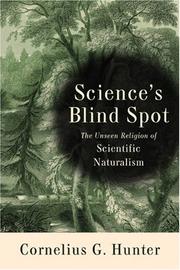
Science's Blind Spot
Cornelius G. Hunter · 2007
Where to buy
Amazon’s price changes daily, so the most accurate place to see it is there, at the moment you buy.
View on AmazonThis is an affiliate link: if you buy through it, the site earns a small commission at no extra cost to you, which helps us bring quality content and maintain the site. As an Amazon Associate we earn from qualifying purchases.
About the book
With the rise in prominence of the Intelligent Design movement (along with its vehement critics), the debate over origins increasingly plays itself out in the scientific community, the courts, the school boards, and the media. A traditional argument of proponents of evolution is that science in general, and evolution in particular, is empirically based, free from any religious or philosophical underpinnings. It follows, then, that science is a more trustworthy perspective on reality. In this thought-provoking book, Cornelius Hunter turns that argument on its head. Through a study of the history of thought, he shows that in fact, modern science has been greatly influenced by theological and metaphysical considerations. This has resulted in the significant influence of what he calls "theological naturalism." Thus, naturalism is not a result of empirical scientific inquiry, but rather a presupposition of science. This bias is science's "blind spot," and it has profound implications for how scientific theories are evaluated and thus advanced or suppressed. In the end, Hunter proposes a better way--moderate empiricism--and shows how intelligent design fits into such a method. Science's Blind Spot provides food for thought for anyone interested in the intersection between scientific and religious thought. - Publisher.
Book details
- Year
- 2007
- Language
- English
- Publisher
- Brazos Press
- Editions
- 5
- Pages
- 176
- ISBN
- 9781587431708
Data source: Wikidata