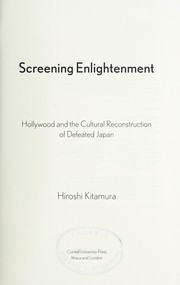
Screening enlightenment
Hiroshi Kitamura · 2010
Where to buy
Check today’s price on Amazon. We do not show prices because they change daily.
View on AmazonAffiliate link. As an Amazon Associate we earn from qualifying purchases.
About the book
"Hiroshi Kitamura offers an insightful consideration of the U.S. film industry's efforts in Japan. He is attentive to not only American cultural dealings with Japan but also Japan's engagement with and influence on the world's cinema." --Andrew Gordon, author of A Modern History of Japan. "In Screening Enlightenment, Hiroshi Kitamura investigates not only the ideologies driving U.S. policymaking but also their effects on individuals at the receiving end of those policies. Kitamura offers an excellent, deeply researched, and smoothly written combination of international business history, Japanese film history, cultural history, and diplomatic history." --Naoko Shibusawa, author of America's Geisha Ally. "Thoroughly researched and carefully crafted, this book provides the first comprehensive study of movie entertainment in post-1945 Japan. As a teenager living in Tokyo at that time, I remember being deeply impressed with such Hollywood productions as Madame Curie, The Yearling, and Little Women. I am grateful that this book helps me understand how these and other movies were selected for showing in Japan, how Hollywood collaborated with U.S. occupation authorities in the process, and how Japan's postwar cultural elites looked to the Hollywood film as a crucial instrument for reconstructing their country and developing a close understanding of, and ties to, the United States. Screening Enlightenment is a valuable addition to the literature on post-World War II history." -Akira Iriye, author of Power and Culture. During the six-and-a-half-year occupation of Japan (1945-1952), U.S. film studios--in close coordination with Douglas MacArthur's Supreme Command for the Allied Powers--launched an ambitious campaign to extend their power and influence in a historically rich but challenging film market. In this far-reaching "enlightenment campaign," Hollywood studios disseminated more than six hundred films to theaters, earned significant profits, and showcased the American way of life as a political, social, and cultural model for the war-shattered Japanese population. In Screening Enlightenment, Hiroshi Kitamura shows how this expansive attempt at cultural globalization helped transform Japan into one of Hollywood's key markets. He also demonstrates the prominent role American cinema played in the "reeducation" and "reorientation" of the Japanese on behalf of the U.S. government. Hollywood achieved widespread results by turning to the support of U.S. government and
Book details
- Year
- 2010
- Language
- English
- Publisher
- Cornell University Press
- Editions
- 1
- Pages
- 263
- ISBN
- 9780801445996
Data source: Wikidata