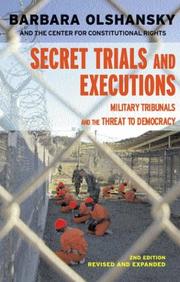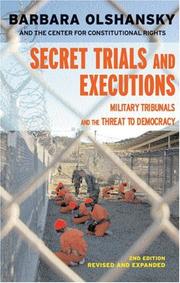
Secret Trials and Executions
Barbara Olshansky · 2006
Where to buy
Amazon’s price changes daily, so the most accurate place to see it is there, at the moment you buy.
View on AmazonThis is an affiliate link: if you buy through it, the site earns a small commission at no extra cost to you, which helps us bring quality content and maintain the site. As an Amazon Associate we earn from qualifying purchases.
About the book
Since the attacks of September 11th, there has been a sweeping revision of U.S. immigration laws, foreign intelligence gathering operations, and domestic law enforcement procedures. While aimed at countering terrorism and bringing to justice those individuals who are responsible for carrying out acts of terror against the U.S., many of these measures also involve a profound curtailment of our constitutional rights and liberties. Among the most controversial of the new measures is the unprecedented order authorizing the creation of special military tribunals to try non-citizens suspected of terrorism. Declaring an "extraordinary emergency," George Bush unilaterally signed the measure into existence on November 13, 2001. With a single swipe of his pen, President Bush replaced the democratic pillars of our legal system with that of a military commission system in which he, or his designee, is rule-maker, investigator, accuser, prosecutor, judge, jury, sentencing court, reviewing court, and jailer or executioner. This system is a radical departure from the key constitutional guarantees considered to be the heart of American democracy: the rights to a presumption of innocence, an independent judiciary, trial by jury, unanimous verdicts, public proceedings, due process, and appeals to higher courts. All of these safeguards against injustice are gone. "The sadness and the sense of crisis that pervades the nation since September 11th is undeniable," writes Barbara Olshansky of the Center for Constitutional Rights. "This fact, however, does not justify even a partial repeal of the Bill of Rights, especially when such a repeal is unnecessary to protect the citizenry." In this Open Media Pamphlet Special Edition, Olshansky helps us step back for a moment to assess several of the Administration's recent policy pronouncements, and examine how the Constitution addresses the cardinal issues of military authority and the requirements of due process and equal protection under the law, and how the courts and Congress have defined the proper roles of the executive, legislative, and judicial branches in our federal government. To provide a framework for this analysis, Olshansky looks at the history of military tribunals, whether the current situation warrants the type of forum proposed by the President, the official positions that our government has taken with regard to the use of military tribunals by other nations, the legal basis for the specific form of military tribunal
Book details
- Year
- 2006
- Language
- English
- Publisher
- Seven Stories Press
- Editions
- 4
- Pages
- 168
- ISBN
- 9781583226346
Data source: Wikidata