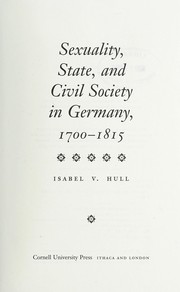
Sexuality, state, and civil society in Germany, 1700-1815
Isabel V. Hull · 1996
Where to buy
Amazon’s price changes daily, so the most accurate place to see it is there, at the moment you buy.
View on AmazonAbout the book
This long-awaited work reconstructs the ways in which the meanings and uses of sex changed during that important moment of political and social configuration viewed as the birth of modernity. Isabel V. Hull analyzes the shift in the "sexual system" which occurred in German-speaking Central Europe when the absolutist state relinquished its monopoly on public life and presided over the formation of an independent civil society. Hull defines a society's sexual system as the patterned way in which sexual behavior is shaped and given meaning through institutions. She shows that as the absolutist state encouraged an independent sphere of public activity, it gave up its theoretically unlimited right to regulate sexual behavior and invested this right in the active citizens of the new civil society. Among the questions posed by this political and social transformation are, When does sexual behavior merit society's regulation? What kinds of behaviors and groups prompt intervention? What interpretive framework does the public apply to sexual behavior? . Hull persuades us that a culture's sexual system can be understood only in relation to the particularities of state, law, and society, and that when state and society are examined through the sexual lens, much conventional wisdom is cast in doubt.
Book details
- Year
- 1996
- Language
- English
- Publisher
- Cornell University Press
- Editions
- 1
- Pages
- 488
- ISBN
- 9780801482533
Data source: Wikidata