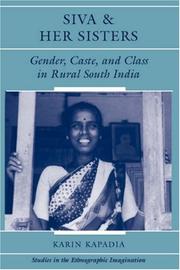
Siva & Her Sisters
Karin Kapadia · 1995
Where to buy
Amazon’s price changes daily, so the most accurate place to see it is there, at the moment you buy.
View on AmazonAbout the book
This book examines two subordinated groups - "untouchables" and women - in a village in Tamilnadu, South India. The lives and work of "untouchable" women in this village provide a unique analytical focus that clarifies the ways in which three axes of identity - gender, caste, and class - are constructed in South India. Karin Kapadia argues that subordinated groups do not internalize the values of their masters but instead reject them in innumerable subtle ways. Kapadia contends that elites who hold economic power do not dominate the symbolic means of production. Looking at the everyday practices, rituals, and cultural discourses of Tamil low castes, she shows how their cultural values repudiate the norms of Brahminical elites. She also demonstrates that caste and class processes cannot be fully addressed without considering their interrelationship with gender.
First sentence: IN THIS BOOK ON EVERYDAY forms of peasant resistance, James Scott argues that the notion of "false consciousness" "typically rests on the assumption that lies dominate not only the physical means of production but the symbolic means of production as well-and that this symbolic hegemony allows them to control the very standards by which their rule is evaluated" (1985:39).
Book details
- Year
- 1995
- Language
- English
- Publisher
- Westview Press
- Editions
- 7
- Pages
- 296
- ISBN
- 9780813334912
Data source: Wikidata