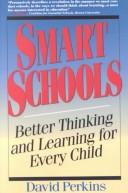
Smart schools
David N. Perkins · 1992
Where to buy
Check today’s price on Amazon. We do not show prices because they change daily.
View on AmazonAffiliate link. As an Amazon Associate we earn from qualifying purchases.
About the book
The past twenty years have seen breakthroughs from cognitive scientists investigating thinking and learning as well as school anthropologists probing the culture of classrooms, schools, and their community contexts; but these insights have yet to be applied to public education on a broad scale. Smart Schools shows how these findings can be effectively used within the classroom. Although there has been much debate over the state of American education today, and a variety of solutions have been offered ranging from school choice to national testing, little attention has been paid to how children actually learn to think. As Perking demonstrates, we cannot solve our education problems by simply redistributing power or by asking children to regurgitate facts on a multiple choice exam; rather we must look at the kinds of knowledge students typically acquire in school. As his own and others' research indicates, students from first grade on through college often have only the most fragile and superficial kind of knowledge even after considerable instruction in a subject. He shows where students typically make mistakes by examining the kinds of misguided strategies they use in trying to understand a topic. He also shows why traditional teaching approaches often result in the students' limited grasp of a subject. Perking then introduces an impressive array of methods that have been shown to dramatically increase a student's understanding.
First sentence: The Hanging Gardens of Babylon counted as one of the seven wonders of the ancient world, alongside the Colossus of Rhodes, the pyramids of Egypt, and the Temple of Artemis at Ephesus.
Book details
- Year
- 1992
- Language
- English
- Publisher
- Prentice Hall College Div
- Editions
- 2
- Pages
- 262
- ISBN
- 9780205195541
Data source: Wikidata
More by David N. Perkins