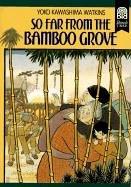
So Far from the Bamboo Grove
Yoko Watkins · 2000
Where to buy
Amazon’s price changes daily, so the most accurate place to see it is there, at the moment you buy.
View on AmazonAbout the book
This book needs to be placed back on the shelf. Yoko Watkins gives us a fictionalized account of her family's escape from North Korea at the end of World War II. However, she narrowly limits the historical setting and plot to avoid the moral issues surrounding her family's presence in Korea in the first place. Her family was in Korea as part of the Japanese imperial drive to conquer of Korea, China, the Pacific and even the western US. They were driven by a race based state religion that saw the Japanese Emperor as being a god and the Japanese as being a superior race destined to rule the world. We may never know the exact extent of Yoko's family's direct or indirect involvement in Japanese war atrocities but this context of history and morality must not be ignored. Living in North Korea, Yoko's father worked to enforce Japanese imperialist plans of carrying out cultural genocide (http://www.cgs.c.u-tokyo.ac.jp/workshops_e/w_2004_02_23_e.html) through attempted eradication of Korean language, history, and forced adoption ofJapanese names, etc.. According to R.J. Rummel's “Statistics of Democide: Genocide and Mass Murder Since 1990”, 5.4 million Koreans were conscripted into forced labor and shipped all over Russia, China, Japan. Hundreds of thousands, if not millions, died under murderous working conditions and untold millions were never repatriated. Their descendants still live in remote areas of Russia, China and constitute the largest minority population in Japan living through what the UN Human Rights Rapporteur described as "deep and profound racism" (http://news.bbc.co.uk/2/hi/asia-pacific/4671687.stm). The Japanese also conscripted an estimated 100,00 to 200,000 teenage girls and women into forced sexual slavery for its military (http://www.nytimes.com/1995/04/06/news/06iht-book_4.html?scp=9&sq=comfort%20women&st=cse). Manchuria, where Yoko's father worked, was the location of Unit 731 where innocent Korean and Chinese civilians were used to conduct medical experiments. Vivasections were performed on men and even pregnant women without anesthesia. Biological weapons were tested on human subjects. These weapons were even used on the US (http://www.nytimes.com/2000/12/21/world/japanese-veteran-testifies-in-war-atrocity-lawsuit.html?scp=5&sq=unit%20731&st=nyt&pagewanted=all, http://www.nytimes.com/1995/03/18/opinion/the-crimes-of-unit-731.html?pagewanted=1). While Yoko herself may be a victim of history, a retelling of her story that ignores these hist
Book details
- Year
- 2000
- Language
- English
- Publisher
- Tandem Library
- Editions
- 1
- ISBN
- 9780833526632
Data source: Wikidata