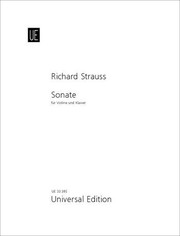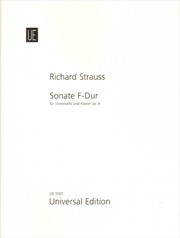
Sonate F-Dur für Violoncello und Klavier op. 6 (1883)
Richard Strauss · 2010
Where to buy
Amazon’s price changes daily, so the most accurate place to see it is there, at the moment you buy.
View on AmazonAbout the book
Richard Strauss begann 1880 mit der Komposition seiner Cellosonate, op. 6. Bis zur Drucklegung im Jahr1883 revidierte er das Werk fast vollständig. Nur der erste Satz wurde in die spätere Fassung übernommen. Die Cellosonate in F-Dur für Violoncello und Klavier widmete Strauss seinem Freund Hans Wihan (damaliger Solocellist der Münchner Hofkapelle), der auch die Uraufführung des Werks in Nürnberg bestritt. - Verlag. Though Strauss is known primarily as a composer of tone poems and operas, he nonetheless made several important contributions to the chamber literature, including the present work. Highly praised following its premiere, the Cello Sonata is dedicated to cellist Hans Wihan, with whose wife, Dora, Strauss fell in love prior to his own marriage to Pauline de Ahna. The Sonata is in three movements -- Allegro con brio, Andante ma non troppo, and Finale: Allegro vivo -- and showcases both Strauss' lyrical melodic writing for cello and his considerable understanding of the piano. Many of the formal difficulties evident in Strauss' earlier efforts, such as excessive repetition, are resolved in this piece as variation reveals itself as a burgeoning and important aspect of his compositional style. The first movement, in sonata form, features a multiplicity of themes in a kind of dialogue. Each theme is actually a group consisting of two contrasting themes: the first and second groups contrast with one another -- per the typical practices of sonata form -- but the themes are also internally divided, each group having one strong, declamatory theme and one of a more gentle, lyrical nature. The movement otherwise closely follows standard first-movement principles and is notable also for the incorporation of a skillful fugato. The second movement is a chorale and, as elsewhere in his music, Strauss is less comfortable with homophonic texture than with polyphony. The final movement is a humorous, canonic Allegro, marked by adventurous harmonies and a lighthearted and rhetorical use of silence that foreshadows Strauss' later works. Though the influence of Mendelssohn is clearly present, early indications of Wagner's increasing influence on Strauss are also in evidence. - Alexander Carpenter at allmusic.com
Book details
- Year
- 2010
- Series
- Universal Violoncello Edition
- Publisher
- Universal Edition
- Editions
- 1
- ISBN
- 9783702427344
Data source: Wikidata
More by Richard Strauss