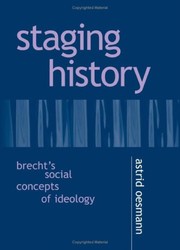
Staging History
Astrid Oesmann · 2005
Where to buy
Amazon’s price changes daily, so the most accurate place to see it is there, at the moment you buy.
View on AmazonThis is an affiliate link: if you buy through it, the site earns a small commission at no extra cost to you, which helps us bring quality content and maintain the site. As an Amazon Associate we earn from qualifying purchases.
About the book
"Staging History analyzes the commitment to social change present in the theatrical and theoretical writings of Bertolt Brecht. Challenging previous notions, Astrid Oesmann argues that Brecht's work was less dependent on Marxist ideology than is often assumed and that his work should be seen as a coherent whole. Brecht used the stage to release political ideas into experimental spaces in which actors and spectators could explore the relationships between abstract thought and concrete social life. Oesmann places Brecht within the context of the major leftist theorists of the twentieth century, particularly Adorno, Benjamin, and Lukacs, focusing on their discussions of realism, aesthetics, natural history, and mimesis. Oesmann elaborates upon the vision of a "counter-public sphere" in a number of Brecht's theoretical texts and plays - especially The Three Penny Trial and Fear and Misery of the Third Reich - that present the emergence of such a sphere in the face of fascism. By exploring Brecht's theoretical writings, selected plays, and recently published theatrical fragments, Oesmann reveals unpredictable constructions of history and surprising distinctions among various political ideologies, while also proving that Brecht remains vitally relevant to a "post-communist" world."--Jacket.
Book details
- Year
- 2005
- Language
- English
- Publisher
- State University of New York Press
- Editions
- 4
- Pages
- 231
- ISBN
- 9780791463857
Data source: Wikidata