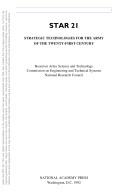
STAR 21
Where to buy
Check today’s price on Amazon. We do not show prices because they change daily.
View on AmazonAffiliate link. As an Amazon Associate we earn from qualifying purchases.
About the book
Dramatic political and economic changes throughout the world, coupled with rapid advances in technology, pose an important question for the U.S. Army: What technologies are best suited to defending U.S. interests against tomorrow's military threats? STAR 21 provides an expert analysis of how the Army can prepare itself for the battlefield of the future--where soldiers will wear "smart" helmets and combat chemical warfare with vaccines produced in days to counter new threats. This book summarizes emerging developments in robotics, "brillant" munitions, medical support, laser sensors, biotechnolgy, novel materials, and other key areas. Taking into account reliability, deployability, and other values that all military systems will need, the volume identifies new systems and emerging technologies that offer the greatest payoff for the Army. The volume addresses a host of important military issues, including the importance of mobile, rapidly deployable forces, the changing role of the helicopter, and how commercial technology may help the Army stay ahead of potential opponents.
Book details
- Year
- 1992
- Language
- English
- Publisher
- National Academies Press
- Editions
- 1
- Pages
- 334
- ISBN
- 9780309046299
Data source: Wikidata
More by National Research Council (US)