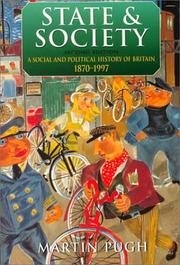
State and society
Martin Pugh · 1994
Where to buy
Amazon’s price changes daily, so the most accurate place to see it is there, at the moment you buy.
View on AmazonThis is an affiliate link: if you buy through it, the site earns a small commission at no extra cost to you, which helps us bring quality content and maintain the site. As an Amazon Associate we earn from qualifying purchases.
About the book
Martin Pugh's volume offers a vigorous new interpretation of political and social developments in Britain since the late-Victorian era. With the skill and insight that characterize his earlier books, he explores as his central theme the relationship between the British state and its citizens. He considers the extent to which negative 'Victorian' ideas about government had begun to erode even while Queen Victoria was on the throne, and emphasizes the Edwardian period as a turning point in the emergence of a more positive view of the state. The Great War, seen as a stimulus to innovation in the short-run, is revealed as a powerful agent of reaction against change in the longer term. As Britain suffered economic decline and political upheaval between the wars, laissez-faire became less attainable, or desirable. The emergence of a phase of consensus in political, social, and economic affairs in the aftermath of the Second World War, and the persistence of that consensus up to the mid 1970s, is a complex phenomenon that receives thorough examination - as do the reasons for the breakdown of post-war policies, in a society in full retreat from great power status, and the attempts since 1979 to return to a state of 'Victorian' proportions, with the rise and fall of Thatcherism viewed in the context of long-term historical changes.
Book details
- Year
- 1994
- Language
- English
- Publisher
- Hodder Education
- Editions
- 6
- Pages
- 400
- ISBN
- 9780340966891
Data source: Wikidata
More by Martin Pugh