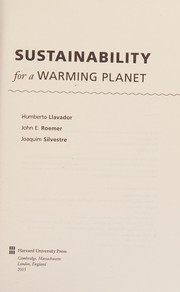
Sustainability for a warming planet
Humberto Llavador · 2015
Where to buy
Amazon’s price changes daily, so the most accurate place to see it is there, at the moment you buy.
View on AmazonThis is an affiliate link: if you buy through it, the site earns a small commission at no extra cost to you, which helps us bring quality content and maintain the site. As an Amazon Associate we earn from qualifying purchases.
About the book
Human-generated greenhouse gas emissions imperil a global resource: a biosphere capable of supporting life as we know it. What is the fair way to share this scarce resource across present and future generations, and across regions of the world? This study offers a new perspective based on the guiding ethics of sustainability and egalitarianism. Sustainability is understood as a pattern of economic activity over time that sustains a given rate of growth of human welfare indefinitely. To achieve this, the atmospheric concentration of carbon must be capped at some level not much higher than exists today, and investments in education and research should be higher than they currently are. International cooperation between developing and developed nations is also vital, because economic growth and the climate problem are intertwined. The authors propose that the guiding principle of bargaining should be that the dates at which developing countries’ living standards catch up with those of developed countries should not be altered by the agreement. They conclude that developed economies would have to agree not to exceed 1 percent growth in per capita GDP annually, while developing nations should grow at a faster rate, but still lower than current projections, until they converge. The authors acknowledge that achieving such a dramatic slowdown would carry political and economic challenges.
Book details
- Year
- 2015
- Language
- English
- Publisher
- Harvard University Press
- Editions
- 4
- Pages
- 320
- ISBN
- 9780674744097
Data source: Wikidata