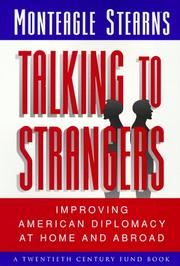
Talking to strangers
Monteagle Stearns · 1996
Where to buy
Amazon’s price changes daily, so the most accurate place to see it is there, at the moment you buy.
View on AmazonThis is an affiliate link: if you buy through it, the site earns a small commission at no extra cost to you, which helps us bring quality content and maintain the site. As an Amazon Associate we earn from qualifying purchases.
About the book
In this discerning book, Monteagle Stearns, a former career diplomat and ambassador, argues that U.S. foreign policymakers do not need a new doctrine, as some commentators have suggested, but rather a new attitude toward international affairs and, most especially, new ways of learning from the Foreign Service. True, the word strangers in his title refers to foreigners. However, it also refers to American foreign policymakers and American diplomats, whose failure to "speak each other's language" deprives American foreign policy of realism and coherence. In a world where regions have become more important than blocs, and ethnic and transnational problems more important than superpower rivalries, American foreign policy must be better informed if it is to be more effective. The insights required will come not from summit meetings or television specials but from the firsthand observations of trained Foreign Service officers. Stearns has not written an apologia for the American Foreign Service, however. Indeed, his criticism of many of its weaknesses is biting. Ranging from a description of Benjamin Franklin's mission to France to an analysis of the Gulf War and its aftermath, he offers a balanced critique of how American diplomacy developed in reaction to European models and how it needs to be changed to satisfy the demands of the twenty-first century.
First sentence: THE LOSS of an enemy can be as disorienting as the loss of a friend.
Book details
- Year
- 1996
- Language
- English
- Publisher
- Princeton University Press
- Editions
- 1
- Pages
- 230
- ISBN
- 9780691007458
Data source: Wikidata