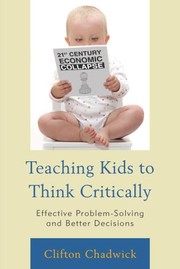
Teaching Kids to Think Critically Effective Problem-Solving and Better Decisions
Clifton B. Chadwick · 2014
Where to buy
Amazon’s price changes daily, so the most accurate place to see it is there, at the moment you buy.
View on AmazonThis is an affiliate link: if you buy through it, the site earns a small commission at no extra cost to you, which helps us bring quality content and maintain the site. As an Amazon Associate we earn from qualifying purchases.
About the book
This book is based on a simple series of psychological concepts. While ability to think has always been important, the knowledge economy significantly increases the demand for higher order thinking and problem-solving abilities. Parents should take a much more active role in teaching their children to think. Early preschool years are critical because long-term attitudes and early strategies are learned then. Approaches and perspectives on learning to think can be clearly communicated to parents in ways which will make it possible for them to use the correct strategies to stimulate their students to think more clearly and critically. There are five elements involved in good, logical, critical, and creative thinking: 1. The skills involved in effective, efficient, and lasting learning, or commonly referred to as cognitive processing strategies; 2. The mastery of logic and structure of what is being learned; 3. Awareness of what one knows and does not know, and how one knows and how one thinks; 4. The standards or guidelines for the validity and reliability of what one knows, called intellectual standards; 5. The knowledge and skills involved in critical thinking and solving problems in different subjects or domains. - Publisher.
Book details
- Year
- 2014
- Language
- English
- Publisher
- Rowman and Littlefield Publishers
- Editions
- 1
- Pages
- 175
- ISBN
- 9781475810653
Data source: Wikidata