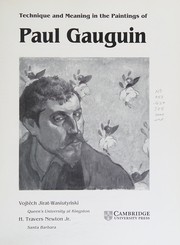
Technique and Meaning in the Paintings of Paul Gauguin
Where to buy
Amazon’s price changes daily, so the most accurate place to see it is there, at the moment you buy.
View on AmazonAbout the book
"Technique and Meaning in the Paintings of Paul Gauguin reinterprets Gauguin's art by reconstructing his painting techniques and their meaning for contemporaries. Using Gauguin as a case study, V. Jirat-Wasiutynski and H. Travers Newton Jr. show that technique provides historical evidence of aesthetic and cultural meaning. Gauguin began as a self-taught amateur in 1873 and, from 1879 to 1885, his techniques were closely modeled on Impressionism. Beginning in 1886, however, Gauguin reevaluated traditional procedures and, like a Renaissance fresco painter, used full-scale cartoons to prepare his monumental figure paintings. In the following years, the delicately textured, matte surfaces and areas of opaque high-key color in his oil paintings deliberately evoked older non-oil media such as tempera and fresco. Contemporary critics responded by calling Gauguin's work "primitive" and "decorative.""--Jacket.
Book details
- Year
- 2000
- Language
- English
- Publisher
- University of Cambridge ESOL Examinations
- Editions
- 1
- Pages
- 312
- ISBN
- 9780521642903
Data source: Wikidata