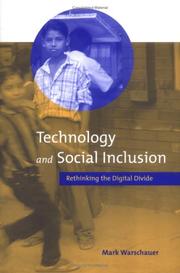
Technology and Social Inclusion
Mark Warschauer · 2003
Where to buy
Amazon’s price changes daily, so the most accurate place to see it is there, at the moment you buy.
View on AmazonAbout the book
Drawing on theory from political science, economics, sociology, psychology, communications, education, and linguistics, this book examines the ways in which differing access to technology contributes to social and economic stratification or inclusion. The author takes a global perspective, presenting case studies from developed and developing countries, including Brazil, China, Egypt, India, and the United States. A central premise is that, in today's society, the ability to access, adapt, and create knowledge using information and communication technologies is critical to social inclusion. This focus on social inclusion shifts the discussion of the "digital divide" from gaps to be overcome by providing equipment to social development challenges to be addressed through the effective integration of technology into communities, institutions, and societies. What is most important is not so much the physical availability of computers and the Internet but rather people's ability to make use of those technologies to engage in meaningful social practices.
First sentence: In 2000 the government of New Delhi, in collaboration with an information technology corporation, established a project, known as the Hole-in-the-Wall experiment, to provide computer access to the city's street children.
Book details
- Year
- 2003
- Language
- English
- Publisher
- The MIT Press
- Editions
- 6
- Pages
- 272
- ISBN
- 9780262232241
Data source: Wikidata
More by Mark Warschauer