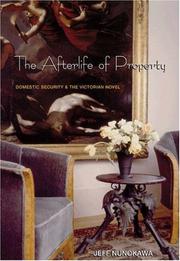
The afterlife of property
Jeff Nunokawa · 2003
Where to buy
Amazon’s price changes daily, so the most accurate place to see it is there, at the moment you buy.
View on AmazonAbout the book
In The Afterlife of Property, Jeff Nunokawa investigates the conviction passed on by the Victorian novel that a woman's love is the only fortune a man can count on to last. Taking for his example four texts, Charles Dickens's Little Dorrit and Dombey and Son, and George Eliot's Daniel Deronda and Silas Marner, Nunokawa studies the diverse ways that the Victorian novel imagines women as property removed from the uncertainties of the marketplace. Along the way, he notices how the categories of economics, gender, sexuality, race, and fiction define one another in the Victorian novel. If the novel figures women as safe property, Nunokawa argues, the novel figures safe property as a woman. And if the novel identifies the angel of the house, the desexualized subject of Victorian fantasies of ideal womanhood, as safe property, it identifies various types of fiction, illicit sexualities, and foreign races with the enemy of such property: the commodity form. Nunokawa shows how these convergences of fiction, sexuality, and race with the commodity form are part of a scapegoat scenario, in which the otherwise ubiquitous instabilities of the marketplace can be contained and expunged, clearing the way for secure possession. The Afterlife of Property addresses literary and cultural theory, gender studies, and gay and lesbian studies.
Book details
- Year
- 2003
- Language
- English
- Publisher
- Princeton University Press
- Editions
- 1
- Pages
- 160
- ISBN
- 9780691114675
Data source: Wikidata