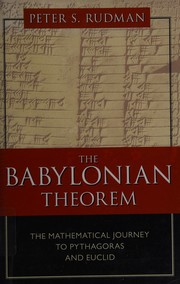
The Babylonian theorem
Peter Strom Rudman · 2010
Where to buy
Check today’s price on Amazon. We do not show prices because they change daily.
View on AmazonAffiliate link. As an Amazon Associate we earn from qualifying purchases.
About the book
"In this sequel to his award-winning How Mathematics Happened, physicist Peter S. Rudman explores the history of mathematics among the Babylonians and Egyptians, showing how their scribes in the era from 2000 to 1600 BCE used visualizations of how plane geometric figures could be partitioned into squares, rectangles, and right triangles to invent geometric algebra, even solving problems that we now do by quadratic algebra. Using illustrations adapted from both Babylonian cuneiform tablets and Egyptian hieroglyphic texts, Rudman traces the evolution of mathematics from the metric geometric algebra of Babylon and Egypt-which used numeric quantities on diagrams as a means to work out problems-to the nonmetric geometric algebra of Euclid (ca. 300 BCE). Thus, Rudman traces the evolution of calculations of square roots from Egypt and Babylon to India, and then to Pythagoras, Archimedes, and Ptolemy. Surprisingly, the best calculation was by a Babylonian scribe who calculated the square root of two to seven decimal-digit precision. Rudman provocatively asks, and then interestingly conjectures, why such a precise calculation was made in a mud-brick culture. From his analysis of Babylonian geometric algebra, Rudman formulates a "Babylonian Theorem", which he shows was used to derive the Pythagorean Theorem, about a millennium before its purported discovery by Pythagoras."--Synopsis.
Book details
- Year
- 2010
- Language
- English
- Publisher
- Prometheus Books
- Editions
- 2
- Pages
- 248
- ISBN
- 9781591027737
Data source: Wikidata