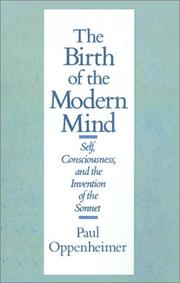
The Birth of the Modern Mind
Paul Oppenheimer · 1989
Where to buy
Amazon’s price changes daily, so the most accurate place to see it is there, at the moment you buy.
View on AmazonAbout the book
This revolutionary study presents new facts and an original theory about the origin of the thought and literature that may be considered "modern." Using fifty-one new translations of sonnets from four languages spanning seven centuries, Oppenheimer argues that "modern" thought and literature were born with the invention of the sonnet in 13th-century Italy. In revealing the sonnet as the first lyric form since the fall of the Roman Empire meant not for music or performance but for silent reading, the book demonstrates that the sonnet was the first modern literatary form deliberately intended to portray the self in conflict and to explore self-consciousness. The wide-ranging essay of Part I traces the influences of the sonnet, as invented by Giacomo da Lentino, combining historical fact with the history of ideas and literary criticism. Part II illustrates, in bilingual format, the sonnet's growing appeal and variety during the centuries that followed with translations from Italian, German, French, and Spanish. The selection presents sonnets by more than thirty-five poets, among them Dante, Petrarch, Goethe, Rilke, Ronsard, Valery, Ibarbourou, and Lorca. The concluding section discusses previous scholarship, offers proofs of the sonnet's introspective and silent inventions, and for the first time establishes the source of the form, in Platonic-Pythagorean mathematics.
Book details
- Year
- 1989
- Language
- English
- Publisher
- Oxford University Press
- Editions
- 2
- ISBN
- 9781280523700
Data source: Wikidata
More by Paul Oppenheimer