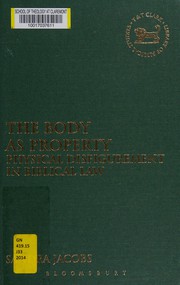
The body as property
Jacobs, Sandra Dr · 2014
Where to buy
Amazon’s price changes daily, so the most accurate place to see it is there, at the moment you buy.
View on AmazonAbout the book
"The Body As Property indicates that physical disfigurement functioned in biblical law to verify legal property acquisition, when changes in the status of dependents were formalized. It is based on the reality the cuneiform script, in particular, was developed in Sumer and Mesopotamia for the purpose of record keeping: to provide legal proof of ownership where the inscription of a tablet evidenced the sale, or transfer, of property. Legitimate property acquisition was as important in biblical law, where physical disfigurements marked dependents, in a similar way that the veil or the head covering identified a wife or concubine in ancient Assyrian and Judean societies. This is primarily substantiated in the accounts of prescriptive disfigurements: namely circumcision and the piercing of a slave's ear, both of which were required only when a son, or slave, was acquired permanently. It is further argued that legal entitlement was relevant also to the punitive disfigurements recorded in Exodus 21:22-24, and Deuteronomy 25:11-12, where the physical violation of women was of concern solely as an infringement of male property rights."--Bloomsbury Publishing The Body As Property indicates that physical disfigurement functioned in biblical law to verify legal property acquisition, when changes in the status of dependents were formalized. It is based on the reality the cuneiform script, in particular, was developed in Sumer and Mesopotamia for the purpose of record keeping: to provide legal proof of ownership where the inscription of a tablet evidenced the sale, or transfer, of property. Legitimate property acquisition was as important in biblical law, where physical disfigurements marked dependents, in a similar way that the veil or the head covering identified a wife or concubine in ancient Assyrian and Judean societies. This is primarily substantiated in the accounts of prescriptive disfigurements: namely circumcision and the piercing of a slave's ear, both of which were required only when a son, or slave, was acquired permanently. It is further argued that legal entitlement was relevant also to the punitive disfigurements recorded in Exodus 21:22-24, and Deuteronomy 25:11-12, where the physical violation of women was of concern solely as an infringement of male property rights
Book details
- Year
- 2014
- Language
- English
- Series
- Library of Hebrew Bible/Old Testament studies -- 582
- Publisher
- Bloomsbury
- Editions
- 1
- Pages
- 260
- ISBN
- 9780567253934
Data source: Wikidata