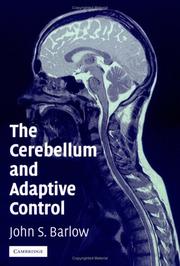
The Cerebellum and Adaptive Control
John S. Barlow · 2002
Where to buy
Amazon’s price changes daily, so the most accurate place to see it is there, at the moment you buy.
View on AmazonAbout the book
"The cerebellum - the region of the vertebrate brain that makes smoothly coordinated movements possible - is a remarkable machine. How it accomplishes its highly complex feats of coordination has been the subject of much inquiry; one of the preeminent theories places adaptive control at the forefront." "The Cerebellum and Adaptive Control reinforces the view that the cerebellum functions as an adaptive control system. That is, it automatically adjusts its output for such eventualities as temporary or lasting weakness of muscle. This text is the first to synthesize the substantial body of literature on the subject, combining the neuroscience of the cerebellum with the science of control theory common to electrical and computer engineers. Organized into four parts, the book examines cerebellar anatomy and physiology, cerebellar function, and models and theories, and ends with a summary and conclusions. The author's clinical perspective offers a broader view of cerebellar function beyond the basic neuroscience. An appendix demonstrates evidence supporting the adaptive control model from a detailed comparison of the cerebellum with an adaptive signal processor of the author's design and construction."--Cover.
First sentence: In the introductory chapter of his magnificent three-volume monograph, The Comparative Anatomy and Histology of the Cerebellum, Olof Larsell (1967; Larsell and Jansen, 1972) provides a history of the cerebellum in its gross aspects, which reads in part as follows (additional historical details can be found in Clarke and O'Malley 1968): Herophilus (335-280 B.C.) is usually credited with recognition
Book details
- Year
- 2002
- Language
- English
- Publisher
- Cambridge University Press
- Editions
- 2
- Pages
- 352
- ISBN
- 9780521018074
Data source: Wikidata