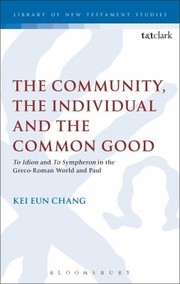
The Community the Individual and the Common Good Library of New Testament Studies
Kei Eun · 2013
Where to buy
Amazon’s price changes daily, so the most accurate place to see it is there, at the moment you buy.
View on AmazonAbout the book
This book investigates Paul's effort to combat factionalism by his use of the Greco-Roman rhetoric of 'the common advantage' to overcome socio-ethical problems caused by the improper exercise of 'private advantage' in Corinth. Chang examines 'the common advantage', first, as a fundamental principle that defined human and societal relationships in the Greco-Roman world. He explores how the neglect and misunderstanding of this principle lay at the root of relational and societal breakdowns. The book further examines Paul's use of the term and demonstrates that, when properly understood and appropriated, the principle of 'the common advantage' is pivotal to keeping societies and relationships dynamic and healthy Conversely, when common advantage is not functioning and, concomitantly, private advantage is wrongly emphasized at its expense, relational, societal and ecclesiastical breakdowns occur. The book culminates in demostrating that, for Paul, 'the common advantage' carries missional and salvific implications that override and subvert socio-ethnic boundaries. In this way, otherwise hostile social groups will realize a healthy symbiosis. --Book cover.
Book details
- Year
- 2013
- Language
- English
- Publisher
- Bloomsbury Publishing PLC
- Editions
- 1
- Pages
- 255
- ISBN
- 9780567362247
Data source: Wikidata