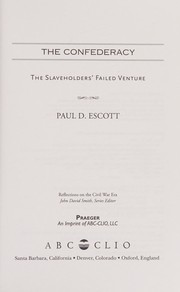
The Confederacy
Paul D. Escott · 2009
Where to buy
Amazon’s price changes daily, so the most accurate place to see it is there, at the moment you buy.
View on AmazonThis is an affiliate link: if you buy through it, the site earns a small commission at no extra cost to you, which helps us bring quality content and maintain the site. As an Amazon Associate we earn from qualifying purchases.
About the book
"It was by any measure a failure. What began at Fort Sumter as a spirited defense of a homeland and a way of life ended in disaster. The connection between battlefield and home front sapped Confederate strength. More fundamentally, the privileged and overconfident elite went to war on false assumptions: that slavery would be a source of strength, that nonslaveholders would continue to sacrifice for slavery, and that women would accept the changes brought by war without serious complaint. The bid to preserve the proslavery South revealed a society whose nature was at odds with the demands of war." "Paul Escott's The Confederacy: The Slaveholders' Failed Venture offers a unique and multifaceted perspective on the United States' most pivotal and devastating conflict, examining the course of the Civil War and analyzing the perspective of the Southern elite class, which was desperate to preserve the "peculiar institution" of its slave-based economy, yet dependent on ordinary Southerners, slaves, and women to sustain the fight for them." "Against the backdrop of the war's military drama and strategic dilemmas, The Confederacy brings into sharp focus the racial, class, gender, and political conflicts that helped destabilize the Confederacy from within. Along the way, Escott shows how time and time again, the South's political and economic elite made errors that further weakened a South already facing a Union army with greater numbers and firepower."--Jacket.
Book details
- Year
- 2009
- Language
- English
- Series
- Reflections on the civil war era
- Publisher
- ABC-CLIO
- Editions
- 3
- Pages
- 175
- ISBN
- 9780275994099
Data source: Wikidata
More by Paul D. Escott