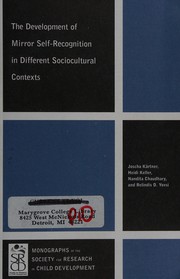
The development of mirror self-recognition in different sociocultural contexts
Joscha Kärtner · 2012
Where to buy
Amazon’s price changes daily, so the most accurate place to see it is there, at the moment you buy.
View on AmazonAbout the book
The goal of the study was to trace the development of mirror self-recognition (MSR), as an index of toddlers' sense of themselves and others as autonomous intentional agents, in different sociocultural environments...[They] hypothesized that the onset of MSR would be earlier in sociocultural contexts in which mothers value and support their toddlers' development of autonomy. Also considered were three factors that covary with culture that may compromise the cross-cultural validity of MSR as a behavioral measure of toddlers' sense of themselves as independent agents: familiarity with mirrors, culture-specific norms of expressive behavior, and motivation for tactile exploration. Finally, [they] analyzed toddlers' reactions to their specular image (e.g. pointing, playmate, and experimenting behavior) across time and culture as well as their relation to MSR. The results indicate that MSR increased with age in all sociocultural contexts. -- from abstract.
Book details
- Year
- 2012
- Language
- English
- Series
- Monographs of the Society for Research in Child Development -- serial no. 305, vol. 77, no. 4, 2012
- Publisher
- Wiley-Blackwell
- Editions
- 1
- Pages
- 101
- ISBN
- 9781118596852
Data source: Wikidata