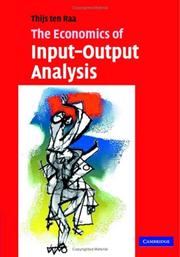
The Economics of Input-Output Analysis
Thijs ten Raa · 2005
Where to buy
Amazon’s price changes daily, so the most accurate place to see it is there, at the moment you buy.
View on AmazonAbout the book
Input-output analysis is the main tool of applied equilibrium analysis. This textbook provides a systematic survey of the most recent developments in input-output analysis and their applications, helping us to examine questions such as: Which industries are competitive? What are the multiplier effects of an investment program? How do environmental restrictions impact on prices? Linear programming and national accounting are introduced and used to resolve issues such as the choice of technique, the comparative advantage of a national economy, its efficiency and dynamic performance. Technological and environmental spillovers are analysed, both at the national level (between industries) and the international level (the measurement of globalisation effects). The book is self-contained, but assumes some familiarity with calculus, matrix algebra, and the microeconomic principle of optimizing behaviour. Exercises and review questions are included at the end of each chapter, and solutions at the end of the book.
First sentence: In An Essay on the Nature and Significance of Economic Science (1984) Lionel Robbins (1898-1984) defines economics as "the science which studies human behavior as a relationship between given ends and scarce means which have alternative uses."
Book details
- Year
- 2005
- Language
- English
- Publisher
- Cambridge University Press
- Editions
- 4
- Pages
- 212
- ISBN
- 9780521602679
Data source: Wikidata
More by Thijs ten Raa