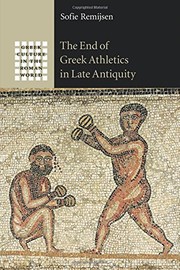
The End of Greek Athletics in Late Antiquity
Sofie Remijsen · 2015
Where to buy
Amazon’s price changes daily, so the most accurate place to see it is there, at the moment you buy.
View on AmazonAbout the book
"Around AD 250 athletics was a significant part of civic life from southern Gaul and northern Africa to Syria and Egypt. Within this broad area, exercising in the gymnasium was a beloved pastime among those members of ancient society who could afford to be (occasionally) at leisure. Hundreds of agones, contests for athletes and/or performing artists, were organized by almost as many cities. Though some of these competitions could look back on centuries-old traditions, most had been founded only a century or even a few decades before, as part of a phenomenon described by Louis Robert as the "agonistic explosion" of the imperial age"-- "This book presents the first comprehensive study of how and why athletic contests, a characteristic aspect of Greek culture for over a millennium, disappeared in late antiquity. In contrast to previous discussions, which focus on the ancient Olympics, the end of the most famous games is analysed here in the context of the collapse of the entire international agonistic circuit, which encompassed several hundred contests. The first part of the book describes this collapse by means of a detailed analysis of the fourth- and fifth-century history of the athletic games in each region of the Mediterranean: Greece, Asia Minor, Syria, Egypt, Italy, Gaul and northern Africa. The second half continues by explaining these developments, challenging traditional theories (especially the ban by the Christian emperor Theodosius I) and discussing in detail both the late antique socio-economic context and the late antique perceptions of athletics."--
Book details
- Year
- 2015
- Language
- English
- Publisher
- Cambridge University Press
- Editions
- 6
- Pages
- 408
- ISBN
- 9781107050785
Data source: Wikidata