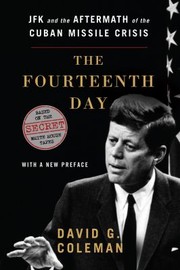
The fourteenth day
David G. Coleman · 2012
Where to buy
Amazon’s price changes daily, so the most accurate place to see it is there, at the moment you buy.
View on AmazonThis is an affiliate link: if you buy through it, the site earns a small commission at no extra cost to you, which helps us bring quality content and maintain the site. As an Amazon Associate we earn from qualifying purchases.
About the book
On October 28, 1962, Soviet Premier Nikita Khrushchev agreed to remove nuclear missiles from Cuba. Conventional wisdom has marked that day as the end of the Cuban Missile Crisis, a seminal moment in American history. As President Kennedy's secretly recorded White House tapes now reveal, the reality was not so simple. Nuclear missiles were still in Cuba, as were nuclear bombers, short-range missiles, and thousands of Soviet troops. From October 29, Kennedy had to walk a very fine line--push hard enough to get as much nuclear weaponry out of Cuba as possible, yet avoid forcing the volatile Khrushchev into a combative stance. On the domestic front, an election loomed and the press was bristling at White House "news management." Using new material from the tapes, historian David G. Coleman puts readers in the Oval Office during one of the most highly charged, and in the end most highly regarded, moments in American history.--From publisher description.
Book details
- Year
- 2012
- Language
- English
- Publisher
- W.W. Norton & Co.
- Editions
- 2
- Pages
- 256
- ISBN
- 9780393084412
Data source: Wikidata
More by David G. Coleman