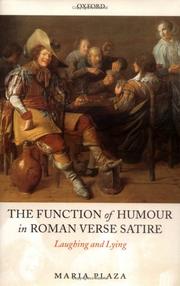
The function of humour in Roman verse satire
Maria Plaza · 2008
Where to buy
Amazon’s price changes daily, so the most accurate place to see it is there, at the moment you buy.
View on AmazonAbout the book
"Maria Plaza offers a fresh and comprehensive analysis of humour in the writings of Horace, Persius, and Juvenal, with an excuses to Lucilius. Her argument is that humour lies at the heart of Roman satire, and holds its paradoxes together. Her first chapter, on 'object-oriented humour', focuses on the recurring metaphors of 'heightening' and 'lowering' the target employed by both Horace and Juvenal. In the case of Juvenal, Plaza argues that his 'heightening' of his objects in Satires 0 and 9 in fact endows them with such vigour that they overpower the satirist himself in a way he did not intend. The second chapter, about the humour which turns back upon the persona, explores Horace's well-calculated self-irony, together with the rougher undermitting of the speaker in Persius and Juvenal. In Chapter 3, on humour that is tied to neither object nor subject. Plaza argues that such 'non-aligned' humour is an important characteristic of the work of both Horace and Juvenal, giving it a dimension of festive 'openness'. She highlights Horace's masterly balancing-act between the poles of extreme positions, and Juvenal's peopling of his world with masters, who are present even in the Golden Age. An epilogue contemplates the end of Roman satire, and its descendants - not only modern satire but also the novel, in which satire's humorous orchestration of epic questions was taken up and richly elaborated."--Jacket.
Book details
- Year
- 2008
- Language
- English
- Publisher
- Oxford University Press, USA
- Editions
- 4
- Pages
- 384
- ISBN
- 9780199237937
Data source: Wikidata