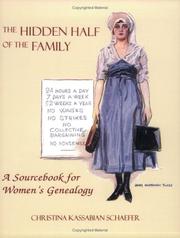
The hidden half of the family
Christina K. Schaefer · 2000
Where to buy
Amazon’s price changes daily, so the most accurate place to see it is there, at the moment you buy.
View on AmazonAbout the book
"By law and by custom women's individual identities have been subsumed by those of their husbands. For centuries women were not allowed to own real estate in their own name, sign a deed, devise a will, or enter into contracts, and even their citizenship and their position as head of household have been in doubt. Finding women in traditional genealogical record sources, therefore, presents the researcher with a unique challenge, for census records, wills, land records, pension records--the conventional sources of genealogical identification--all have to be viewed in a different perspective if we are to establish the genealogical identity of our female ancestors. Whether listed under their maiden names, married names, patronymic/matronymic surnames or some other permutation, or hidden under such terms as "Mrs.," "Mistress," "goodwife," "wife of," or even "daughter of," it is clear that women are hard to find.^ But while women may never be as easy to locate as their male counterparts, Christina Schaefer here pioneers an approach to the problem that just might set genealogy on its head! And her solution is simplicity itself: Look closely at those areas where the female ancestor interacts with the government and the legal system, she advises, where law, precedent, and even custom mandate the unequivocal identification of all parties, male and female. According to this thesis, the legal status of women at any point in time is the key to unraveling the identity of the female ancestor, and therefore this work highlights those laws, both federal and state, that indicate when a woman could own real estate in her own name, devise a will, enter into contracts, and so on.^ The first part of the book--a lengthy and informative introduction--deals with the special ways women are dealt with in federal records such as immigration records, passports, naturalization records, census enumerations, land records, military records, and records dealing with minorities. All such records are discussed with reference to their impact on women, as are a group of miscellaneous, non-governmental records, including newspapers, cemetery records, city directories, church records, and state laws covering common law marriages and marriage and divorce registration. The bulk of this absorbing new reference work, however, deals with the individual states, showing how their laws, records, and resources can be used in determining female identity. Each state section begins with a time line of event
Book details
- Year
- 2000
- Language
- English
- Publisher
- Genealogical.com
- Editions
- 1
- ISBN
- 9780806320588
Data source: Wikidata