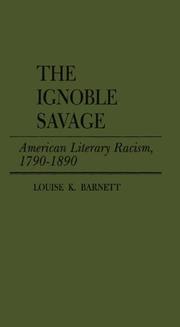
The ignoble savage
Louise K. Barnett · 1975
Where to buy
Amazon’s price changes daily, so the most accurate place to see it is there, at the moment you buy.
View on AmazonThis is an affiliate link: if you buy through it, the site earns a small commission at no extra cost to you, which helps us bring quality content and maintain the site. As an Amazon Associate we earn from qualifying purchases.
About the book
In the first century of American nationhood, the clash of Indian and white cultures found expression in a unique literary genre: the frontier romance. Written by a white author for a white audience, the frontier romance typically included a genteel hero and heroine, a rugged frontiersman, and both hostile and friendly Indians. The Indians were completely stereotyped. From captivity narratives and Puritan chronicles, fiction borrowed the figure of the bad Indian: treacherous, vengeful, superstitious, and totally inimical to whites. Good Indians, in contrast were devoted to whites: subservient, loyal, and self-sacrificing. Both were ignoble savages. Whites were depicted as superior not only in civilized arts, but in wilderness skills. Even in evil, the white man who pursued vengeance was able to out-Indian the Indian in killing and scalping. The white was portrayed as sexually more attractive than the Indian. Both Hawthorne and Melville made use of frontier situations in their writing, and both exposed the racism on which Indian stereotypes were founded. They viewed the white man's destruction of primitive peoples as the true barbarism. In this perception they stood apart from their contemporaries in American literature.
Book details
- Year
- 1975
- Language
- English
- Publisher
- Greenwood Press
- Editions
- 1
- Pages
- 220
- ISBN
- 9780837182810
Data source: Wikidata
More by Louise K. Barnett