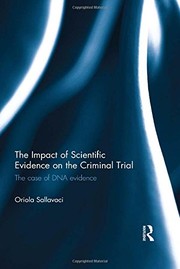
The Impact of Scientific Evidence on the Criminal Trial
Oriola Sallavaci · 2014
Where to buy
Amazon’s price changes daily, so the most accurate place to see it is there, at the moment you buy.
View on AmazonAbout the book
"The English criminal trial is of central importance in the structure of the criminal justice system. It is traditionally perceived as a public, oral and continuous event in which the prosecution case is presented and tested by professional lawyers in front of an impartial adjudicator and the verdict of guilty beyond reasonable doubt reached by the jury is based solely on the evidence presented to the court. Today the contested criminal trial faces many challenges which affect its traditional principles and values, features and procedures as well as its very existence. This book considers how the increasing use of and reliance upon scientific evidence in the fact finding process is a significant factor in challenging the traditional principles and procedures of criminal trial. While exploring the use of DNA evidence it identifies challenges which until now have received remarkably little attention. The book draws on interviews with key personnel including forensic scientists, lawyers and police to examine some of the limitations of existing theories of the criminal trial process in the face of the increased use of scientific evidence in the court room. The book contends that tensions arise when scientific evidence is relied upon at trial in part because of its complexity but also because of the scientific illiteracy of many trial actors, unfounded expectations as to what scientific evidence can and cannot do, and inadequate pre-trial communication between lawyers and experts. The book concludes by advocating measures to help question undue deference to scientific reasoning currently frequently mirrored in trial narratives which can mislead the jury"-- "This book explores challenges posed by the use of DNA evidence to the traditional features, procedures and principles of the criminal trial. It examines some limitations of existing theories of the criminal trial process in the face of the increased use of scientific evidence in the court room. The research elucidates the interconnections at trial of three epistemologies, namely legal reasoning, as represented by counsel and trial judge, common sense manifested by the jury and scientific reasoning expounded by the expert witness. Scientific reasoning is part of this hybrid of trial languages and practices but its extended use is producing specifically novel tensions which impact on the traditional criminal trial landscape. Through the lens of DNA evidence, Oriola Sallavaci investigates how far the use of sci
Book details
- Year
- 2014
- Language
- English
- Publisher
- Routledge
- Editions
- 9
- Pages
- 224
- ISBN
- 9780415720205
Data source: Wikidata