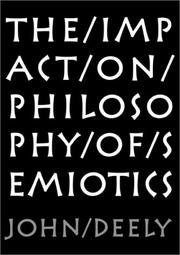
The Impact on Philosophy of Semiotics
John N. Deely · 2003
Where to buy
Amazon’s price changes daily, so the most accurate place to see it is there, at the moment you buy.
View on AmazonAbout the book
"This book is a coherent argument about the meaning of the term "postmodern" as it applies to philosophy at the opening of the twenty-first century. The author makes the case that the twentieth-century development of the doctrine of signs, commonly known as semiotics, represents the positive essential thrust giving birth to a postmodern era of philosophy, as clean a break with modern thought as modern thought was with Latin scholasticism in the time of Galileo, Poinsot, and Descartes - but with a difference. Contrary to what the author dismisses as false claims of postmodernity, the work shows that what is truly postmodern in philosophy both goes beyond modernity and recovers philosophy's past in a renewed understanding of the human condition. The "problem of the external world," which modern philosophy began by creating, postmodern philosophy begins by revealing as a quasi-error. The book concludes with a philosophical dialogue revealing the inadequacy to the postmodern situation of a simple return to any past form of "realism," and explaining why the postmodern situation calls for a new definition of human being as "the semiotic animal.""--Jacket.
Book details
- Year
- 2003
- Language
- English
- Publisher
- St. Augustine's Press
- Editions
- 1
- Pages
- 264
- ISBN
- 9781587313752
Data source: Wikidata
More by John N. Deely