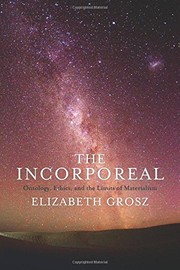
The Incorporeal
Elizabeth Grosz · 2017
Where to buy
Amazon’s price changes daily, so the most accurate place to see it is there, at the moment you buy.
View on AmazonThis is an affiliate link: if you buy through it, the site earns a small commission at no extra cost to you, which helps us bring quality content and maintain the site. As an Amazon Associate we earn from qualifying purchases.
About the book
Philosophy has inherited a powerful impulse to embrace either dualism or a reductive monism-either a radical separation of mind and body or the reduction of mind to body. But from its origins in the writings of the Stoics, the first thoroughgoing materialists, another view has acknowledged that no forms of materialism can be completely self-inclusive-space, time, the void, and sense are the incorporeal conditions of all that is corporeal or material. Elizabeth Grosz argues that the ideal is inherent in the material and the material in the ideal, and, by tracing its development over time, she makes the case that this same idea reasserts itself in different intellectual contexts. Grosz shows that not only are idealism and materialism inextricably linked but that this "belonging together" of the entirety of ideality and the entirety of materiality is not mediated or created by human consciousness. Instead, it is an ontological condition for the development of human consciousness. Grosz draws from Spinoza's material and ideal concept of substance, Nietzsche's amor fati, Deleuze and Guattari's plane of immanence, Simondon's preindividual, and Raymond Ruyer's self-survey or autoaffection to show that the world preexists the evolution of the human and that its material and incorporeal forces are the conditions for all forms of life, human and nonhuman alike.
Book details
- Year
- 2017
- Language
- English
- Publisher
- Columbia University Press
- Editions
- 3
- Pages
- 336
- ISBN
- 9780231181624
Data source: Wikidata
More by Elizabeth Grosz